Glucosamine and chondroitin: do they really work?

🎯 Quick verdict
Glucosamine sulfate 1500 mg/day may help with mild to moderate osteoarthritis - but only the sulfate form and only after 8-12 weeks. Chondroitin alone is weak evidence. UC-II collagen (40 mg) is superior to glucosamine in new studies. MSM + curcumin (Meriva) are good supplements. If after 3 months there is no effect, switch to UC-II.
Glucosamine and chondroitin: $3 billion a year - for what?
Glucosamine and chondroitin are the best-selling joint supplements in the world. Annual turnover is more than $3 billion. They are taken by millions of people with arthrosis, knee pain and “crunchy” joints. But the scientific evidence is surprisinglyconflicting: some studies show an effect, others do not.
In this article we will look at who these supplements really help, which forms work and which are dummies, and which alternatives are worth considering.
What are glucosamine and chondroitin
Glucosamine
A natural component of cartilage tissue is an aminosaccharide from which the body builds glycosaminoglycans (GAG), the basis of the cartilage matrix. With age, its own synthesis slows down, cartilage loses water and elasticity, and begins to thin out.
The logic of the supplement: to give the body “building material” for the restoration of cartilage from the outside.
Chondroitin
A component of connective tissue, a large polysaccharide that retains water within the cartilage matrix, providing shock absorption. Also inhibits enzymes that destroy cartilage (metalloproteinases).
Main study: GAIT (2006)
The largest study of glucosamine and chondroitin is GAIT (Glucosamine/Chondroitin Arthritis Intervention Trial). 1583 participants with knee osteoarthritis, 24 weeks, NIH funded (not manufacturers).
The results were surprising:
- Glucosamine aloneis no better than placebo in the overall group
- Chondroitin alone is no better than placebo
- BUT: In the subgroup with moderate-severe pain, the combination of glucosamine + chondroitin showed a significant effect - pain reduction by 79.2% vs 54.3% placebo
Why such contradictory results? There are several explanations:
- Form matters: GAIT used glucosamine hydrochloride, not sulfate. European studies with thesulfate formshow better results
- The placebo effect is huge: 60% of participants in the placebo group noted improvement - joint pain is highly dependent on expectations
- Stage of the disease: In severe arthrosis, the cartilage is already destroyed - there is nothing to “feed”. Supplements work in the early stages
Which form of glucosamine works
Glucosamine sulfate is the ONLY proven form
The most important nuance: not all forms of glucosamine are equivalent.
- Glucosamine sulfate is the most studied form. A European 3-year RCT (GUIDE, Reginster 2001) showed slower joint space narrowing and reduced pain. It is this form that is included in the recommendations of ESCEO (European Society for Clinical and Economic Aspects of Osteoporosis)
- Glucosamine Hydrochloride - contains more elemental glucosamine by weight, but less evidence of effectiveness. Not recommended
- N-acetylglucosamine - another mechanism, more for the intestines than for the joints
Rule: “Glucosamine Sulfate” must be written on the label. If it says “Glucosamine HCl”, this is a different form with less evidence base.
Alternatives with better evidence base
UC-II collagen - the new gold standard?
UC-II (Undenatured Collagen Type II) - undenatured type II collagen. It works in a fundamentally different way: not as a “building material”, but through oral immune tolerance.
Mechanism: with osteoarthritis, the immune system attacks its own cartilage. UC-II “educates” the immune system through the intestines: stop attacking type II collagen in the joints.
- Dose: only 40 mg/day (not grams, but milligrams!)
- Take on an empty stomach - important for immune modulation
- RCT Lugo et al. (2016):UC-II was superior to the combination of glucosamine + chondroitin in reducing pain and improving joint function
Curcumin (Meriva or Longvida form)
Powerful anti-inflammatory - in studies comparable to ibuprofen for pain relief in osteoarthritis, but without side effects on the gastrointestinal tract. Important: only forms with increased bioavailability (regular curcumin is absorbed less than 1%).
MSM (methylsulfonylmethane)
Source of organic sulfur - a building material for cartilage and ligaments. 1000-3000 mg/day reduces pain and inflammation. Combines well with glucosamine.
Strategy by stages
Initial stage (crunching, slight discomfort)
- Glucosamine sulfate1500 mg + chondroitin1200 mg daily
- Omega-3 2000 mg EPA+DHA (anti-inflammatory effect)
- Evaluation after 3 months
Middle stage (pain on exertion)
- UC-II collagen40 mg on an empty stomach
- Meriva Curcumin 1000 mg (instead of or together with NSAIDs)
- MSM 2000-3000 mg
- Omega-3 2000-3000 mg
Advanced stage (constant pain)
- Supplements - only as an addition to the doctor's treatment
- UC-II + curcumin + omega-3 may reduce the need for NSAIDs
- Consider hyaluronic acid injections (with your podiatrist)
Reception rules
- Glucosamine: 1500 mg/day, can be divided into 3 doses of 500 mg, with food
- Chondroitin: 800-1200 mg/day, with food
- UC-II:40 mg strictly on an fastingbefore bed (for immune modulation)
- Do not combine UC-II with regular collagen/glucosaminein the same dose - different mechanisms
- Minimum course: 8-12 weeks (cartilage is restored slowly)
- If there is no improvement after 3 months, change your strategy
Security
- Shellfish Allergy: Glucosamine is often obtained from shrimp/crab shells. If you are allergic, take a synthetic one (on the package: “shellfish-free”)
- Diabetes: Glucosamine is an aminosaccharide. Previously, there were fears of an increase in sugar, but studies have shown: does not affect glycemiain therapeutic doses
- Anticoagulants: Chondroitin is structurally similar to heparin. When taking warfarin - INR monitoring
- Pregnancy:Insufficient data - refrain
Resume from Novird
Glucosamine and chondroitin are not a dummy, but not a miracle remedy. They may help with early osteoarthritis, especially in the form of glucosamine sulfate. But if there is no effect after 3 months, switch to UC-II collagen, which in new studies shows better results.
- Start: Glucosamine sulfate 1500 mg + Chondroitin 1200 mg
- No effect after 3 months:UC-II 40 mg + Meriva Curcumin
- Always:Omega-3 to reduce inflammation
Important: Supplements slow down the destruction of cartilage, but do not grow new ones. The sooner you start, the more cartilage you can save. If the pain is serious, consult an orthopedist.
| Dose | Proof | Additive | For what | Effect through | Our assessment |
|---|---|---|---|---|---|
| 1500 mg/day | ★★★★☆ (GAIT, European RCTs) | Glucosamine sulfate | Osteoarthritis, slowing cartilage destruction | 8-12 weeks | Good starting option |
| 800-1200 mg/day | ★★★☆☆ (better in combination) | Chondroitin sulfate | With glucosamine for moderate pain | 8-12 weeks | Only paired with glucosamine |
| 40 mg/day | ★★★★☆ (superior to GC in a number of RCTs) | UC-II collagen | Mobility, immunomodulation of cartilage | 4-8 weeks | ★★★★★ Best alternative |
| 1000-3000 mg/day | ★★★☆☆ | MSM | Pain, inflammation, swelling | 4-6 weeks | Nice addition |
| 500-1000 mg/day | ★★★★☆ | Curcumin (Meriva) | Inflammation, pain (comparable to ibuprofen) | 4-8 weeks | Strong anti-inflammatory |
| 200 mg/day | ★★★☆☆ | Hyaluronic acid | Joint lubrication, fluid viscosity | 8-12 weeks | Nice addition |
| 1500 mg/day | ★★☆☆☆ (weaker than sulfate) | Glucosamine hydrochloride | Joints (but less data) | 8-12 weeks | We do not recommend - take sulfate |
← Прокрутите таблицу вправо →
Recommended products
NOW Foods
NOW Foods Glucosamine Sulfate
Glucosamine sulfate — building block for cartilage. Slows degradation in osteoarthritis. Evidence base (GAIT, European RCTs). Effect after 8-12 weeks.
NOW Foods
NOW Foods Chondroitin Sulfate
Chondroitin attracts water into cartilage, boosts resilience. Works in combination with glucosamine for moderate pain. Effect after 8-12 weeks.
NOW Foods
NOW Foods MSM 1000 mg
MSM — bioavailable sulfur for connective tissue. Reduces joint pain, inflammation and swelling. Good complement to glucosamine. Effect after 4-6 weeks.
Thorne
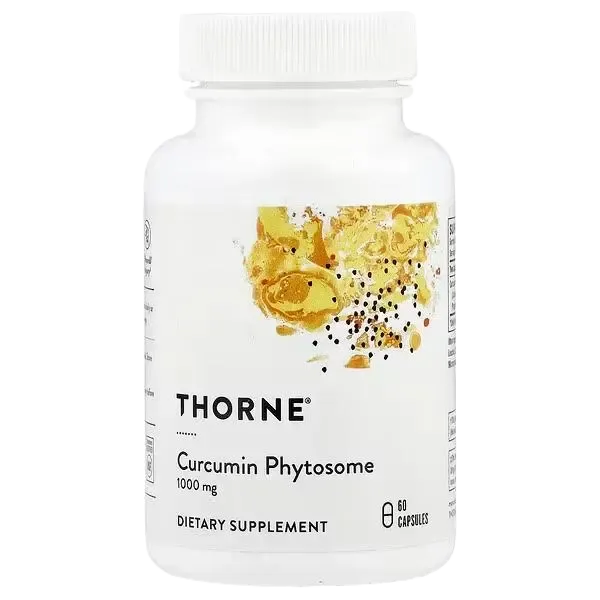
Thorne Curcumin Phytosome (Meriva)
Meriva curcumin — 29x more bioavailable than ordinary. Reduces inflammation and pain (comparable to ibuprofen in RCTs). Most studied curcumin. Effect after 4-8 weeks.
Doctor's Best
Doctor's Best Hyaluronic Acid
Hyaluronic acid — lubricates joints, increases synovial fluid viscosity. Good complement for mobility. Effect after 8-12 weeks.
NOW Foods
NOW Foods Glucosamine HCl
Glucosamine HCl — more concentrated form (less sodium). Supports joints, but slightly less evidence than sulfate. No added salt.
NOW Foods
NOW Foods UC-II (collagen type II)
Undenatured type II collagen (UC-II) — targeted for cartilage and joints. Small dose (40 mg) works via immune modulation. Type II is the one for joints.
Doctor's Best
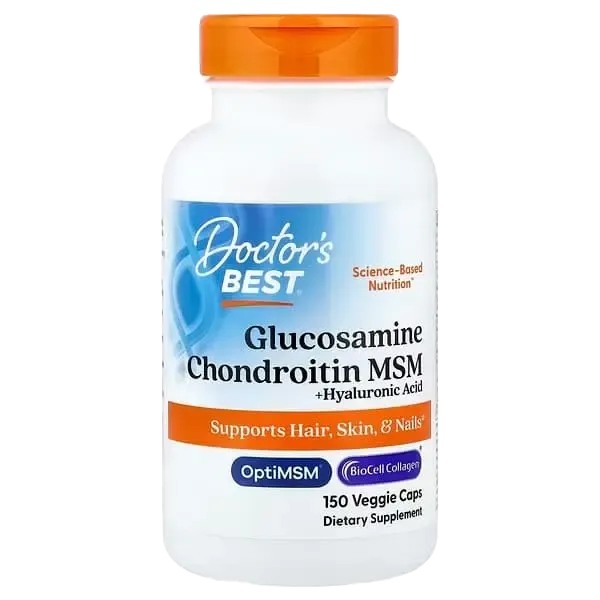
Doctor's Best Glucosamine Chondroitin MSM + Hyaluronic
4-in-1 combo: glucosamine + chondroitin + MSM (OptiMSM) + hyaluronic acid (BioCell). Complete joint support in one bottle. Convenient instead of 4 supplements.
Sources and studies
Related articles
Iron: how to take it correctly and not cause harm
Iron is a double-edged sword. Deficiency = fatigue, excess = toxicity. Complete guide to forms and doses.
The best nootropics : what really improves memory
We analyze nootropics with an evidence base: Omega-3 DHA, Lion's Mane, Creatine, L-Theanine and Alpha-GPC.
Magnesium for the heart: why cardiologists recommend taurate
Magnesium taurate is the optimal form for the cardiovascular system. Taurine + magnesium = double heart protection.